

Most Read Business & Finance News — Q2 2026
This is the Business & Finance instalment of the Q2 2026 quarterly series. Every ranking here derives from one signal: real readers clicking real articles, as reflected in each outlet's own Most Read list. How the recording and scoring work is documented in full on the methodology page.
The longest-lived story of the entire quarter — by total time on a list — wasn't a market story at all. Astha Chaturvedi's essay on leaving a fifteen-year green-card backlog to rebuild a life in Bengaluru held a Most Read list for 194 hours — eight days — longer than anything else tracked across all nine sources this quarter. It never spent more than 10% of that time at #1 in a single stint; it simply refused to leave the list.
I track five Business & Finance sources. Financial Times and The Wall Street Journal only came online mid-quarter, so this report draws on the three with complete Q2 data: Business Insider, CNBC and Forbes. The other two debut in the Q3 report.
How the sources compare
Business & Finance doesn't move like a single audience. Across the nine sources tracked for the full quarter, the median article holds a slot for 6 hours — and this vertical's three sources land at three different points around that baseline: Business Insider ties Ars Technica for the second-longest median in the entire dataset, behind only The Verge — a tie that holds on the direct count and breaks on the reconstruction-inclusive one, where Ars pulls ahead of both; CNBC is the fastest in the dataset; and Forbes sits just below the ecosystem's pooled median, at 5 hours (its 90th percentile runs longer).
| Organization | Median Duration (Hours) | Median, +reconstructed | 90th Percentile Duration (Hours) | Turn Rate (Per 24h) |
|---|---|---|---|---|
| Business Insider | 16.0 | 16.0 | 57.0 | 1.50 |
| Forbes | 5.0 | 5.0 | 32.0 | 4.80 |
| CNBC | 3.0 | 3.0 | 15.0 | 8.00 |
| All 9 sources, pooled | 6.0 | 7.0 | 24.0 | 4.00 |
The first median counts only readings my scraper actually took; the second also counts short gaps filled by interpolation. All three sources here are unmoved by the choice — the distinction matters elsewhere in the dataset, not in this vertical. The 90th Percentile and Turn Rate columns are on the direct count.
Definitions for these metrics are on the methodology page; the full nine-source comparison is in the quarterly overview.
A note on Forbes's data. Forbes has the lowest directly recorded share of this vertical's three sources — 90.6% of its Q2 readings were captured first-hand, the rest reconstructed from surrounding readings (Business Insider and CNBC are both above 99.7% direct). Its coverage of the quarter is still strong at 96.7%, and unlike Ars Technica or AP News elsewhere in this dataset, Forbes's median doesn't move between counting methods — only its 90th percentile shifts, by about three hours. Full detail on the methodology page.
Same vertical, three different appetites
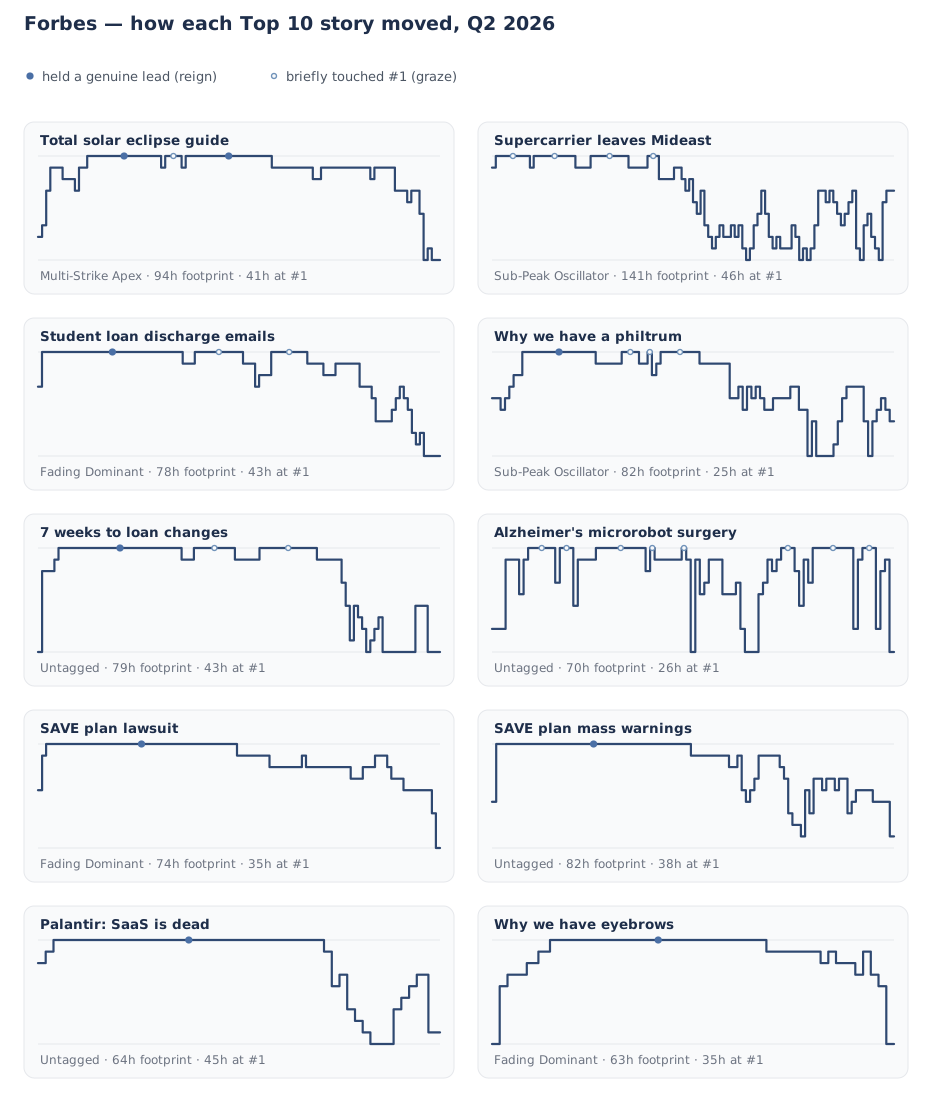
That spread tracks how fast each outlet's popular stories fade off the list — and the position-data shapes show the same split. Seven of Business Insider's ten most-read stories this quarter are personal essays or as-told-to accounts — someone leaving the US for Bengaluru, downsizing into a Paris micro-apartment or a narrowboat, rebuilding a fortune lost overnight. Stories like these have no news peg to expire, so they tend to keep drawing clicks for days rather than spiking once and dropping off: five of BI's ten carry a Sub-Peak Oscillator shape, touching #1 repeatedly but never dominating it, staying in circulation instead. Seven of CNBC's ten, by contrast, are hard news — an oil-tanker standoff at the Strait of Hormuz, an IPO, a bubble warning from a famous short-seller, a Treasury policy fight — the kind of event-driven story that spikes the day it breaks and gets displaced as the next one lands: four of its ten are Fading Dominants, a quick commanding spike followed by a clean exit. Forbes sits in the middle on the numbers but carries this report's highest untagged share, four of ten — three of them pieces with a genuine dominant reign undone by a noisy tail rather than a clean fade, exactly the pattern the strict tail rule is designed to leave untagged rather than force into a shape.
One thing holds across all three despite the differences: unlike World News, where the two longest-lived stories never reached #1 at all, every single Business & Finance deep-dive touched the top of its list at least once — even the 194-hour green-card essay, which never held it for more than a tenth of its life at a time. In these three Top 10s, every story got its moment at #1; some just didn't stay.
Most Read Articles at a glance
Entries are ranked by the Popularity Score, which weights both how long an article stayed on a list and how high it climbed. Position weighs heavily — an hour at #1 is worth many times an hour at the foot of the list — so an entry can rank above one showing a longer footprint and more time at #1. The exact formula is not published.
Top 10 - Business Insider, Q2 2026
- My husband and I spent years waiting for green cards. We left the US and built the life we wanted in India.
- Firefighter testifies he lost most of $110K in retirement savings after investing in companies criticized by Andrew Left
- I live in a 97-square-foot micro-apartment in Paris. It was supposed to be temporary, but I realized I love tiny living.
- I moved to another state to be closer to my kids and grandkids. It wasn't the dream I thought it would be.
- I moved from California to Texas for a fresh start. It was much more affordable there, but I was still unhappy and moved back.
- The 20 most peaceful countries in the world, ranked
- A woman lives in a 50-foot narrowboat she bought for around $40,000. It saves her over $1,000 each month.
- I bought a 54-acre ranch to teach my kids self-reliance. Then I lost millions overnight and learned another lesson.
- I asked strangers to let me grow flowers in their yards, and 40 people said yes. I turned their kindness into a business.
- A US Army brigade used hundreds of attack drones in a recent wargame. Soldiers built more than half of them themselves.
Top 10 - CNBC, Q2 2026
- At 103 years old, I’m the ‘world’s oldest doctor’: My 3 rules for a long, happy life are so simple—I tell it to 'all my patients'
- The average SpaceX buyer post-IPO is almost under water after two-day slide
- Treasury Secretary Scott Bessent is preparing banks to collect citizenship data
- Video shows ships turning away from the Strait of Hormuz as confusion persists over whether sea lane is really open
- 36-year-old left the U.S. for China—now pays $1,000 rent and $100 for groceries for family of 4: It's my 'version of the American Dream’
- SpaceX IPO live updates: Elon Musk's company set for biggest market debut ever
- Bessent says to adjust your paycheck withholding — but mistakes could trigger a tax bill, experts caution
- Michael Burry says the market today feels like 'the last months of the 1999-2000 bubble'
- American couple left New York City and bought a house in Italy for $13,000: 'We found a different way of life'
- India makes first Iranian oil purchase in seven years with no payment problems
Top 10 - Forbes, Q2 2026
- 50 Days To A Total Solar Eclipse — Where And When To Experience It
- The U.S. Navy’s Largest Supercarrier Has Departed The Middle East
- Student Loan Discharge Emails Sent To 30,000 Borrowers As Settlement Relief Proceeds
- 5 Things Borrowers With Federal Student Loans Should Do In The Next 7 Weeks, As Trump Changes Take Effect
- Why Do Humans Have A Philtrum? An Evolutionary Biologist Explains The Groove Above Your Lip
- First U.S. Patients Treated With Microrobotic Surgery For Alzheimer’s
- Student Loans Must Be Forgiven And Cannot Be Kicked Off SAVE Plan, Says Amended Lawsuit
- Education Department Sends Mass Warnings To Student Loan Borrowers To Change Repayment Plans, Or Else
- Palantir Says SaaS Is Dead
- Why Do Humans Have Eyebrows? An Evolutionary Biologist Explains
Archetype taxonomy
Each deep-dive below is tagged with a shape — how the article moved through the list over its lifetime — wherever one of these shapes applies. A reign is a real stint at #1 (at least 15% of the article's Total Index Footprint); a dominant reign is one of at least 30%; a graze is a passing touch at #1 below the reign threshold. The seven shapes are defined by fixed quantitative rules:
| Archetype | Quantitative definitional rules |
|---|---|
| Multi-Strike Apex | Two or more separate #1 blocks, each lasting at least 15% of the article's Total Index Footprint, combined with a total footprint of 70 hours or more — two genuine commanding stints at the top, not incidental touches. |
| Monolithic Overlord | A single continuous block at #1 accounting for 80% or more of the article's Total Index Footprint. |
| Perennial Contender | Never reaches #1, yet sustains a Total Index Footprint of 70 hours or more while making three or more distinct upward moves among the lower slots — a long-lived runner-up that stayed in contention without ever topping the list. |
| Sub-Peak Oscillator | Reaches #1 but never holds it for a single continuous stint of 30% or more of its Total Index Footprint — no dominant reign — then makes three or more distinct upward moves among the below-#1 slots after leaving the top. |
| Abrupt Cliff | Held a dominant reign at #1 — a single continuous block of 30% or more of the Total Index Footprint — then falls from the top by two or more slots, to #3 or worse, on its final departure from a genuine stint (not a lone passing touch), with no subsequent return to #1. |
| Soft-Landing Decline | Reaches #1 exactly once, after which every recorded move is non-improving — each reading at the same slot or lower. |
| Fading Dominant | Held a dominant reign at #1 — a single continuous block of 30% or more of the Total Index Footprint — then fades: after it last leaves #1 the trajectory trends downward, with no single recovery of more than two slots. The noisy-tailed counterpart to the Soft-Landing Decline. |
Where an article satisfies more than one rule, the shape is assigned by precedence — Multi-Strike Apex, then Monolithic Overlord, Perennial Contender, Sub-Peak Oscillator, Abrupt Cliff, Soft-Landing Decline, Fading Dominant — so the rarest qualifying pattern wins. A few articles match no shape and are left untagged rather than forced into one.
A closer look: Business Insider
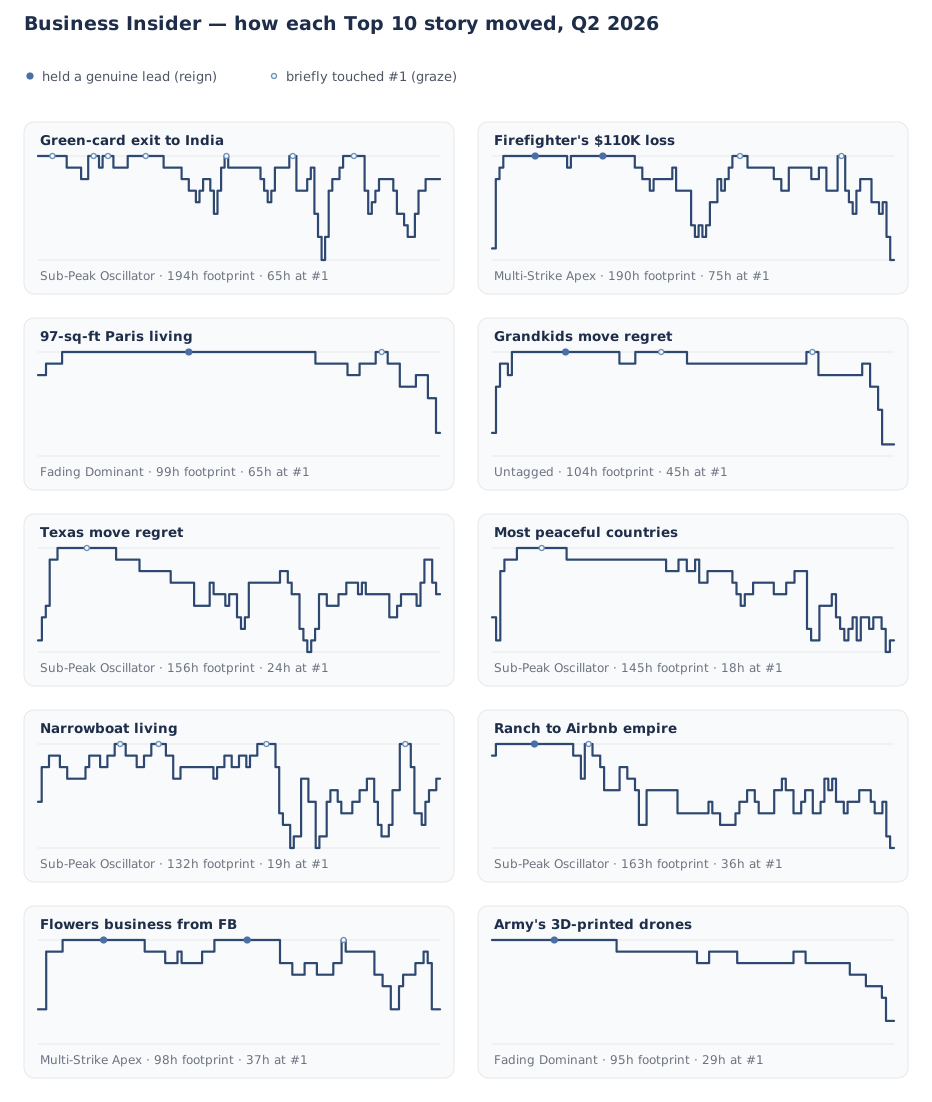
1. My husband and I spent years waiting for green cards. We left the US and built the life we wanted in India.
- Peak Residency:
65 hours at #1 - Total Index Footprint:
194 hours - Position Path:
1 (8%) → 2 (4%) → 3 (2%) → 1 (3%) → 2 (1%) → 1 (3%) → 2 (4%) → 1 (10%) → 2 (5%) → 3 (2%) → 4 (2%) → 5 (1%) → 4 (1%) → 3 (2%) → 4 (1%) → 6 (1%) → 4 (1%) → 2 (1%) → 1 (1%) → 2 (9%) → 3 (1%) → 4 (1%) → 5 (1%) → 4 (1%) → 2 (4%) → 1 (2%) → 4 (3%) → 3 (1%) → 2 (1%) → 6 (1%) → 8 (1%) → 10 (1%) → 8 (1%) → 4 (1%) → 3 (2%) → 2 (1%) → 1 (6%) → 4 (1%) → 6 (1%) → 5 (1%) → 4 (1%) → 3 (4%) → 4 (1%) → 6 (2%) → 7 (1%) → 8 (2%) → 6 (1%) → 4 (2%) → 3 (4%) - Shape:
Sub-Peak Oscillator
Astha Chaturvedi's as-told-to account of leaving Big Tech and a fifteen-year green-card backlog behind — selling a $2.3 million San Francisco home to rebuild a life and a business in Bengaluru — turned into the largest Total Index Footprint of the entire quarter: 194 hours, more time on a list than anything else tracked across all nine sources. It's the quit-your-job, sell-the-house genre, framed around stakes far broader than US immigration limbo itself — a seven-figure home sale weighed against a new life abroad. The longevity came without ever holding the top — seven separate touches at #1, none of them topping 10% of its life. But it stayed high while it lasted: roughly three-quarters of its eight days in the top three slots, and barely a tenth of it below #5.
2. Firefighter testifies he lost most of $110K in retirement savings after investing in companies criticized by Andrew Left
- Peak Residency:
75 hours at #1 - Total Index Footprint:
190 hours - Position Path:
9 (1%) → 3 (1%) → 2 (1%) → 1 (17%) → 2 (1%) → 1 (17%) → 2 (2%) → 3 (2%) → 4 (1%) → 3 (5%) → 2 (1%) → 4 (4%) → 7 (1%) → 8 (1%) → 7 (1%) → 8 (1%) → 7 (1%) → 5 (2%) → 3 (1%) → 4 (1%) → 3 (1%) → 2 (1%) → 1 (4%) → 2 (7%) → 3 (2%) → 4 (2%) → 2 (6%) → 3 (2%) → 2 (2%) → 4 (3%) → 1 (2%) → 4 (1%) → 5 (1%) → 6 (1%) → 4 (1%) → 3 (3%) → 5 (2%) → 6 (1%) → 5 (1%) → 8 (1%) → 10 (1%) - Shape:
Multi-Strike Apex
Billy Banks' courtroom testimony sits at the center of Andrew Left's ongoing securities-fraud trial — a retired firefighter describing how roughly $110,000 of his retirement savings evaporated after he chased cannabis stocks CV Sciences and Namaste, both later targeted by the short-seller's negative reports. Left's defense counters that he never told anyone to buy either stock, and that his calls turned out to be right — a genuinely contested case rather than a settled verdict, and the story's pull looks more like courtroom-drama interest than an outcome readers had already picked a side on. It hit #1 in two near-identical 17% blocks in quick succession early on — two genuine commanding stints rather than one — then grazed the top twice more at a few percent each while working down the list over the rest of its 190-hour run.
3. I live in a 97-square-foot micro-apartment in Paris. It was supposed to be temporary, but I realized I love tiny living.
- Peak Residency:
65 hours at #1 - Total Index Footprint:
99 hours - Position Path:
3 (2%) → 2 (4%) → 1 (63%) → 2 (8%) → 3 (3%) → 2 (4%) → 1 (3%) → 2 (3%) → 4 (4%) → 3 (3%) → 5 (2%) → 8 (1%) - Shape:
Fading Dominant
Naydeline Mejia's essay on her 97-square-foot Paris chambre de bonne — a former maid's room she took as emergency housing and grew to love, for the lower rent, the forced decluttering, and the push to socialize instead of hiding out in four cramped walls — taps into the minimalism-versus-homeownership conversation head-on, most explicitly in her own aside about being priced out of the traditional path. It opened with a commanding 63% block at #1, touched the top once more briefly later on, then eased down the list for the rest of its 99-hour run without ever spiking back up by more than a couple of slots at a time.
4. I moved to another state to be closer to my kids and grandkids. It wasn't the dream I thought it would be.
- Peak Residency:
45 hours at #1 - Total Index Footprint:
104 hours - Position Path:
8 (1%) → 4 (1%) → 2 (2%) → 3 (1%) → 1 (27%) → 2 (4%) → 1 (13%) → 2 (30%) → 1 (3%) → 3 (11%) → 2 (2%) → 4 (2%) → 6 (1%) → 9 (3%) - Shape:
Untagged
Feliz Hebert's essay about relocating to Somers, Connecticut to be near her children and grandchildren, only to find a one-street town and grown kids too busy with their own routines for the closeness she'd pictured, is the familiar retiree's-regret arc — until she and her husband moved back to Cape Cod and found the community and the golf courses they'd missed. Its climb topped out at a 27% block at #1, well short of a dominant reign, and after its last visit to the top the trajectory manages only a single rebound before drifting off the list for good — not enough oscillation to earn a shape, so this one goes untagged.
5. I moved from California to Texas for a fresh start. It was much more affordable there, but I was still unhappy and moved back.
- Peak Residency:
24 hours at #1 - Total Index Footprint:
156 hours - Position Path:
9 (1%) → 7 (1%) → 6 (1%) → 2 (2%) → 1 (15%) → 2 (6%) → 3 (8%) → 4 (6%) → 6 (4%) → 4 (1%) → 5 (3%) → 6 (1%) → 5 (2%) → 7 (1%) → 8 (1%) → 7 (1%) → 4 (8%) → 3 (2%) → 4 (1%) → 5 (2%) → 8 (1%) → 9 (1%) → 10 (1%) → 9 (1%) → 8 (1%) → 5 (2%) → 6 (3%) → 5 (2%) → 4 (3%) → 5 (1%) → 4 (1%) → 5 (6%) → 7 (2%) → 6 (1%) → 5 (4%) → 6 (1%) → 4 (1%) → 2 (2%) → 4 (1%) → 5 (1%) - Shape:
Sub-Peak Oscillator
Priscila Barros' essay on trading Murrieta, California, for a bigger, cheaper house in Houston — only to be worn down by the heat, the mold in a rushed new-build, and homesickness for mountains and beaches her kids no longer had — sits in Business Insider's recurring state-comparison genre, with the California-versus-Texas divide as its stated frame. It touched #1 just once, for exactly 15% of its life — the minimum needed to count as a real stint — then spent the rest of its 156 hours working through repeated small climbs and drops across the lower half of the list.
6. The 20 most peaceful countries in the world, ranked
- Peak Residency:
18 hours at #1 - Total Index Footprint:
145 hours - Position Path:
7 (1%) → 9 (1%) → 3 (1%) → 2 (3%) → 1 (12%) → 2 (24%) → 3 (3%) → 2 (2%) → 3 (2%) → 2 (1%) → 4 (2%) → 3 (6%) → 4 (1%) → 5 (1%) → 6 (1%) → 5 (2%) → 4 (5%) → 5 (3%) → 4 (2%) → 3 (3%) → 8 (1%) → 9 (2%) → 6 (3%) → 5 (1%) → 7 (1%) → 8 (1%) → 9 (1%) → 8 (1%) → 7 (1%) → 9 (1%) → 7 (2%) → 8 (1%) → 7 (2%) → 8 (1%) → 10 (1%) → 9 (1%) - Shape:
Sub-Peak Oscillator
This ranked list of the world's most peaceful countries, tied to the 2026 Global Peace Index and pegged to a rising share of Americans telling Gallup they'd consider moving abroad, is the kind of evergreen reference piece that keeps drawing clicks long after publication rather than spiking once. It only ever grazed #1 — a single 12% touch, short of a genuine stint — before spending the bulk of its 145-hour footprint oscillating through the middle and lower slots.
7. A woman lives in a 50-foot narrowboat she bought for around $40,000. It saves her over $1,000 each month.
- Peak Residency:
19 hours at #1 - Total Index Footprint:
132 hours - Position Path:
6 (1%) → 3 (2%) → 2 (3%) → 3 (2%) → 4 (5%) → 3 (1%) → 2 (3%) → 3 (2%) → 2 (2%) → 1 (3%) → 2 (3%) → 3 (2%) → 2 (2%) → 1 (4%) → 2 (2%) → 4 (2%) → 3 (9%) → 4 (1%) → 3 (2%) → 2 (2%) → 3 (2%) → 2 (2%) → 3 (1%) → 2 (2%) → 1 (5%) → 3 (1%) → 7 (1%) → 8 (2%) → 10 (1%) → 9 (2%) → 4 (2%) → 6 (2%) → 10 (1%) → 9 (2%) → 6 (1%) → 5 (2%) → 6 (1%) → 7 (3%) → 6 (2%) → 5 (2%) → 4 (2%) → 6 (1%) → 8 (1%) → 9 (2%) → 8 (1%) → 5 (2%) → 1 (3%) → 3 (1%) → 7 (2%) → 8 (1%) → 6 (1%) → 5 (2%) → 4 (1%) - Shape:
Sub-Peak Oscillator
Dottie Turnbull's account of renovating a 50-foot narrowboat she bought for about $40,000 — ripping out damp green carpet, repainting dark wood white, opening up the kitchen herself — plays into the same affordable-alternative-housing appeal running through the ranch and micro-apartment entries elsewhere on this list. It only ever grazed #1, four separate touches of no more than 5% each, and spent nearly all of its 132-hour run oscillating through the lower half of the list instead.
8. I bought a 54-acre ranch to teach my kids self-reliance. Then I lost millions overnight and learned another lesson.
- Peak Residency:
36 hours at #1 - Total Index Footprint:
163 hours - Position Path:
2 (1%) → 1 (20%) → 2 (2%) → 4 (1%) → 1 (2%) → 2 (2%) → 3 (1%) → 5 (4%) → 3 (2%) → 4 (2%) → 5 (1%) → 8 (2%) → 5 (8%) → 7 (8%) → 6 (1%) → 7 (2%) → 8 (4%) → 7 (1%) → 6 (2%) → 5 (2%) → 6 (1%) → 7 (4%) → 5 (2%) → 4 (1%) → 5 (2%) → 7 (2%) → 6 (1%) → 5 (2%) → 7 (2%) → 6 (1%) → 4 (1%) → 5 (1%) → 4 (1%) → 6 (2%) → 7 (1%) → 6 (3%) → 5 (3%) → 6 (1%) → 7 (2%) → 6 (1%) → 9 (1%) → 10 (1%) - Shape:
Sub-Peak Oscillator
Brent Phillips' story of buying a Texas ranch to teach his kids self-reliance, only to lose a multimillion-dollar net worth overnight when his former company's stock dropped from $55 to $5 a share, and rebuilding through an accidental Airbnb operation that now sleeps 150 guests a night, is a full-reversal financial narrative whose stakes are legible from the headline alone. It reached #1 for a real but non-dominant 20% stint, then spent most of its 163-hour footprint oscillating through the middle of the list.
9. I asked strangers to let me grow flowers in their yards, and 40 people said yes. I turned their kindness into a business.
- Peak Residency:
37 hours at #1 - Total Index Footprint:
98 hours - Position Path:
7 (2%) → 2 (4%) → 1 (20%) → 2 (5%) → 3 (3%) → 2 (1%) → 3 (5%) → 2 (3%) → 1 (16%) → 3 (3%) → 4 (3%) → 3 (3%) → 4 (4%) → 3 (2%) → 1 (1%) → 2 (7%) → 4 (2%) → 5 (2%) → 7 (2%) → 5 (1%) → 4 (3%) → 3 (2%) → 2 (1%) → 3 (1%) → 7 (2%) - Shape:
Multi-Strike Apex
Marisa Mender-Franklin's account of a single Facebook post to a neighborhood "Buy Nothing" group — which brought 40 offers of free yard space and grew into a flower-subscription business now employing seven people — is a straightforward feel-good entrepreneurial story built on a community's generosity. It reached #1 in 20% and 16% commanding blocks separated by a stretch in the lower slots — two distinct commanding runs — with one more fleeting touch at the top later, across its 98-hour footprint.
10. A US Army brigade used hundreds of attack drones in a recent wargame. Soldiers built more than half of them themselves.
- Peak Residency:
29 hours at #1 - Total Index Footprint:
95 hours - Position Path:
1 (31%) → 2 (20%) → 3 (3%) → 2 (7%) → 3 (14%) → 2 (3%) → 3 (11%) → 4 (4%) → 5 (4%) → 6 (1%) → 8 (2%) - Shape:
Fading Dominant
Col. Ryan Bell's account of a 101st Airborne brigade fielding 228 attack drones in a Fort Polk wargame — more than half of them soldier-built from 3D-printed parts and off-the-shelf components, a tactic drawn directly from lessons in Ukraine — reads as a straightforward military-technology story rather than an emotional one. It opened with a dominant 31% block at #1, then faded steadily through the rest of its 95-hour run, with no single rebound climbing back more than one slot at a time.
A closer look: CNBC
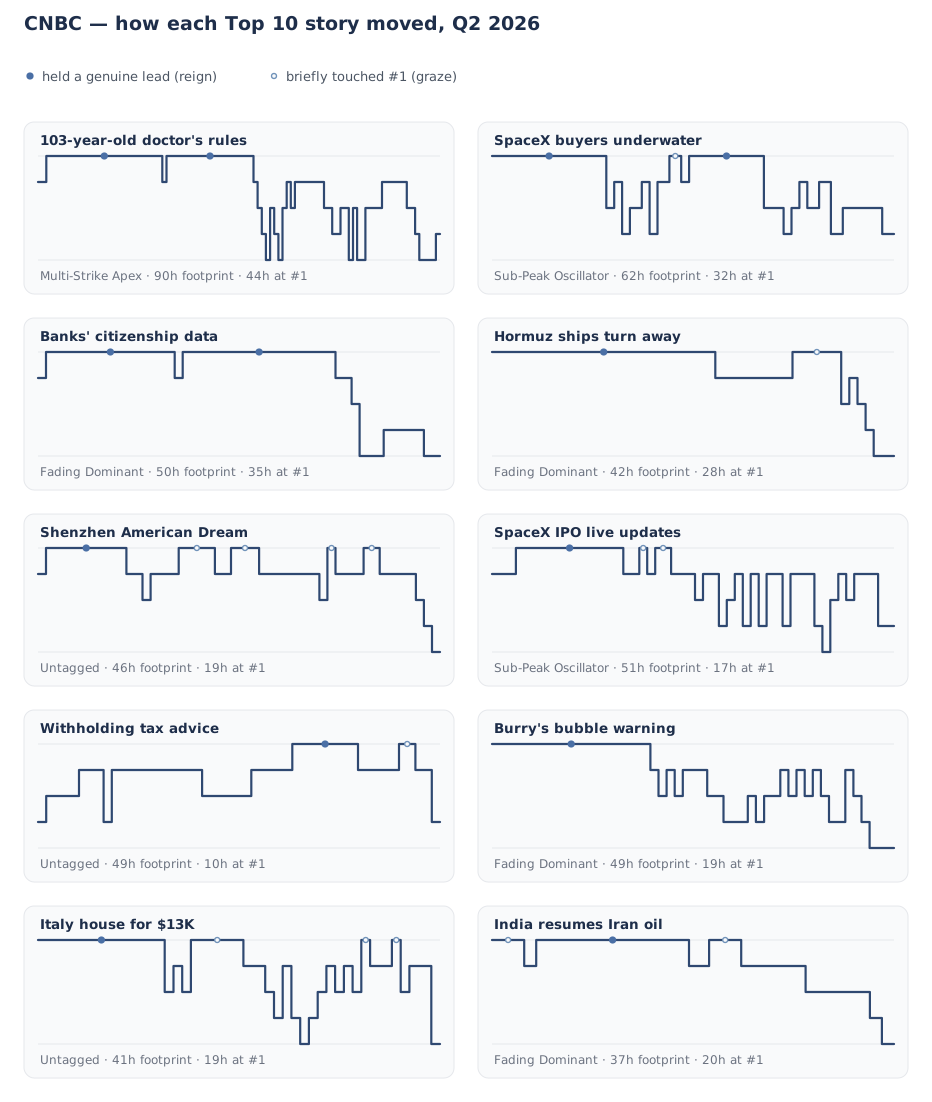
1. At 103 years old, I’m the ‘world’s oldest doctor’: My 3 rules for a long, happy life are so simple—I tell it to 'all my patients'
- Peak Residency:
44 hours at #1 - Total Index Footprint:
90 hours - Position Path:
2 (2%) → 1 (28%) → 2 (1%) → 1 (21%) → 2 (1%) → 3 (1%) → 4 (1%) → 5 (1%) → 3 (1%) → 4 (1%) → 5 (1%) → 3 (1%) → 2 (1%) → 3 (1%) → 2 (7%) → 3 (2%) → 4 (2%) → 3 (2%) → 5 (1%) → 3 (1%) → 5 (2%) → 3 (4%) → 2 (6%) → 3 (2%) → 4 (1%) → 5 (4%) → 4 (1%) - Shape:
Multi-Strike Apex
Dr. Howard Tucker's essay on his three rules for a long life — keep the mind engaged, let go of hatred, enjoy things in moderation — carries a weight CNBC discloses upfront: Tucker, the Guinness-certified oldest doctor ever at 103, died before this ran, and it's published with his family's permission. Whether the pull came from the advice or from news of his death circulating beyond the article is more than position data can say — what it shows is the climb. The story reached #1 twice, in 28% and 21% blocks separated by a return trip through the lower slots, adding up to two distinct commanding runs across its 90-hour footprint.
2. The average SpaceX buyer post-IPO is almost under water after two-day slide
- Peak Residency:
32 hours at #1 - Total Index Footprint:
62 hours - Position Path:
1 (29%) → 3 (2%) → 2 (2%) → 4 (2%) → 3 (3%) → 2 (2%) → 4 (2%) → 2 (3%) → 1 (3%) → 2 (2%) → 1 (19%) → 3 (5%) → 4 (2%) → 3 (2%) → 2 (2%) → 3 (3%) → 2 (3%) → 4 (3%) → 3 (10%) → 4 (3%) - Shape:
Sub-Peak Oscillator
SpaceX stock retreating 20% from its post-IPO highs — enough to bring the average buyer who'd chased shares in the open market back to roughly breakeven — is a quick-reversal story whose hook sits right in the headline. It opened with a 29% block at #1, just short of a dominant reign, then returned to the top again later for 19% more; two genuine stints, but at only 62 hours total its footprint falls well short of the 70-hour bar a two-strike pattern needs, so it settles instead into repeated smaller climbs through the lower slots the rest of the way.
3. Treasury Secretary Scott Bessent is preparing banks to collect citizenship data
- Peak Residency:
35 hours at #1 - Total Index Footprint:
50 hours - Position Path:
2 (2%) → 1 (32%) → 2 (2%) → 1 (38%) → 2 (4%) → 3 (2%) → 5 (6%) → 4 (10%) → 5 (4%) - Shape:
Fading Dominant
Treasury Secretary Scott Bessent's push for banks to collect citizenship data — tied to a coming executive order and framed by Bessent as closing a loophole that lets "unknown foreign nationals" bank freely — sits inside a genuine immigration-enforcement dispute, with banks and policy groups warning about cost and access on one side and Republican lawmakers pushing for stricter rules on the other. It built two separate dominant reigns, 32% and 38% of its life, but at only 50 hours total that's well short of the 70-hour bar a genuine two-strike pattern needs; instead the story fades afterward, its rebounds never climbing back more than a slot at a time.
4. Video shows ships turning away from the Strait of Hormuz as confusion persists over whether sea lane is really open
- Peak Residency:
28 hours at #1 - Total Index Footprint:
42 hours - Position Path:
1 (55%) → 2 (19%) → 1 (12%) → 3 (2%) → 2 (2%) → 3 (2%) → 4 (2%) → 5 (5%) - Shape:
Fading Dominant
Confusion over whether the Strait of Hormuz is actually open — Iran's foreign minister called it "completely open" while Revolutionary Guard-aligned media kept the same restrictive conditions in place, and Trump insisted the US naval blockade stays — is a story about unresolved stakes rather than a settled outcome, with oil futures swinging on the ambiguity itself. It opened with a commanding 55% block at #1, briefly returned to the top once more, then declined through the rest of its 42-hour run without any single rebound climbing back more than a slot.
5. 36-year-old left the U.S. for China—now pays $1,000 rent and $100 for groceries for family of 4: It's my 'version of the American Dream’
- Peak Residency:
19 hours at #1 - Total Index Footprint:
46 hours - Position Path:
2 (2%) → 1 (20%) → 2 (4%) → 3 (2%) → 2 (7%) → 1 (9%) → 2 (4%) → 1 (7%) → 2 (15%) → 3 (2%) → 1 (2%) → 2 (7%) → 1 (4%) → 2 (9%) → 3 (2%) → 4 (2%) → 5 (2%) - Shape:
Untagged
Bradley Krae's essay on rebuilding an American-Dream narrative in Shenzhen — $1,000-a-month rent, $100 grocery bills, and a marketing job that pays less than teaching English but buys back his time — is a straightforward lifestyle-and-cost piece, the kind of expat account that draws readers on curiosity about a place rather than any dispute over its merits. Its best stretch at #1 topped out at 20%, short of a dominant reign, and after its last visit to the top it declined steadily with no upward move back through the list at all — a tail too quiet for any shape to claim, so it's left untagged.
6. SpaceX IPO live updates: Elon Musk's company set for biggest market debut ever
- Peak Residency:
17 hours at #1 - Total Index Footprint:
51 hours - Position Path:
2 (6%) → 1 (27%) → 2 (4%) → 1 (2%) → 2 (2%) → 1 (4%) → 2 (6%) → 3 (2%) → 2 (4%) → 4 (2%) → 3 (2%) → 2 (2%) → 4 (2%) → 2 (2%) → 4 (2%) → 2 (4%) → 4 (2%) → 2 (6%) → 4 (2%) → 5 (2%) → 3 (2%) → 2 (2%) → 3 (2%) → 2 (6%) → 4 (4%) - Shape:
Sub-Peak Oscillator
This is CNBC's live-updates thread on SpaceX's Nasdaq debut, continuously refreshed through the day with new items on Musk's trillionaire status, record retail-trading activity, wealth-tax criticism from Mamdani and Warren, and skeptical valuation calls from CFRA's Keith Snyder. Its best block at #1 topped out at 27%, short of a dominant reign, and it kept climbing back up the list in smaller pushes throughout its 51-hour run instead of fading cleanly after one commanding stretch.
7. Bessent says to adjust your paycheck withholding — but mistakes could trigger a tax bill, experts caution
- Peak Residency:
10 hours at #1 - Total Index Footprint:
49 hours - Position Path:
4 (2%) → 3 (8%) → 2 (6%) → 4 (2%) → 2 (22%) → 3 (12%) → 2 (10%) → 1 (16%) → 2 (10%) → 1 (4%) → 2 (4%) → 4 (2%) - Shape:
Untagged
Treasury Secretary Bessent's advice to adjust paycheck withholding for a bigger take-home check ran into pushback from tax professionals warning that blanket changes can trigger a surprise bill next filing season — practical financial advice with real expert disagreement attached, not a settled recommendation. It managed one real stint at #1, 16% of its life, and after its last visit to the top it dropped off the list almost immediately — too short a tail to register any real oscillation, so it stays untagged.
8. Michael Burry says the market today feels like 'the last months of the 1999-2000 bubble'
- Peak Residency:
19 hours at #1 - Total Index Footprint:
49 hours - Position Path:
1 (39%) → 2 (2%) → 3 (2%) → 2 (2%) → 3 (2%) → 2 (6%) → 3 (4%) → 4 (6%) → 3 (2%) → 4 (2%) → 3 (4%) → 2 (2%) → 3 (2%) → 2 (2%) → 3 (2%) → 2 (2%) → 3 (2%) → 4 (4%) → 2 (2%) → 3 (2%) → 4 (2%) → 5 (6%) - Shape:
Fading Dominant
Michael Burry's warning that the AI-stock rally is starting to resemble the final months of the 1999-2000 dot-com bubble — a comparison Paul Tudor Jones has also drawn, though Jones thinks the rally still has a year or two left — lands the story squarely in a genuine dispute among prominent investors rather than a consensus call. It opened with a dominant 39% block at #1, then faded overall through the rest of its 49-hour run, with occasional rebounds back through the list that never climbed more than two slots at a time.
9. American couple left New York City and bought a house in Italy for $13,000: 'We found a different way of life'
- Peak Residency:
19 hours at #1 - Total Index Footprint:
41 hours - Position Path:
1 (29%) → 3 (2%) → 2 (2%) → 3 (2%) → 1 (12%) → 2 (5%) → 3 (2%) → 4 (2%) → 2 (2%) → 4 (2%) → 5 (2%) → 4 (2%) → 3 (2%) → 2 (2%) → 3 (2%) → 2 (2%) → 3 (2%) → 1 (2%) → 2 (5%) → 1 (2%) → 3 (2%) → 2 (5%) → 5 (2%) - Shape:
Untagged
Cassandra Tresl's essay on buying a two-bedroom house in Abruzzo, Italy for $13,100 cash — and trading a New York City pace of life for a hilltop town where neighbors drop by unannounced — is another entry in the same aspirational-relocation genre running through this quarter's most-read lists. Its best stretch at #1 reached 29%, just short of a dominant reign, and after its last visit to the top the trajectory only managed a single rebound before falling off the list — too little late movement for any of the seven shapes to apply, so it goes untagged.
10. India makes first Iranian oil purchase in seven years with no payment problems
- Peak Residency:
20 hours at #1 - Total Index Footprint:
37 hours - Position Path:
1 (8%) → 2 (3%) → 1 (38%) → 2 (5%) → 1 (8%) → 2 (16%) → 3 (16%) → 4 (3%) → 5 (3%) - Shape:
Fading Dominant
India's resumption of Iranian oil and gas purchases after a seven-year pause — a calculated hedge against Strait of Hormuz disruptions and a signal that New Delhi won't fully align with Washington's naval coalition against Tehran — is a geopolitical balancing-act story rather than an emotional one, with analysts describing it as pragmatism rather than a stance on the underlying conflict. It built to a dominant 38% block at #1, briefly returned to the top once more, then faded through the rest of its 37-hour run without any rebound climbing back more than a slot.
A closer look: Forbes
1. 50 Days To A Total Solar Eclipse — Where And When To Experience It
- Peak Residency:
41 hours at #1 - Total Index Footprint:
94 hours - Position Path:
8 (1%) → 7 (1%) → 4 (1%) → 2 (3%) → 3 (3%) → 4 (1%) → 2 (2%) → 1 (18%) → 2 (1%) → 1 (4%) → 2 (1%) → 1 (21%) → 2 (10%) → 3 (2%) → 2 (12%) → 3 (1%) → 2 (5%) → 4 (3%) → 5 (1%) → 4 (2%) → 6 (1%) → 10 (1%) → 9 (1%) → 10 (2%) - Shape:
Multi-Strike Apex
Jamie Carter's countdown guide to the August 12 total solar eclipse — the first visible from Iceland since 1954 and from Spain since 1905, with the path also crossing the peak of the annual Perseid meteor shower — is service journalism for an event still seven weeks out. It reached #1 in 18% and 21% commanding blocks, with a brief 4% touch between them, adding up to two separate commanding runs across its 94-hour footprint.
2. The U.S. Navy’s Largest Supercarrier Has Departed The Middle East
- Peak Residency:
46 hours at #1 - Total Index Footprint:
141 hours - Position Path:
2 (1%) → 1 (9%) → 2 (1%) → 1 (11%) → 2 (4%) → 1 (10%) → 2 (5%) → 1 (3%) → 3 (4%) → 2 (2%) → 3 (1%) → 4 (1%) → 3 (1%) → 5 (1%) → 6 (1%) → 4 (1%) → 7 (1%) → 8 (1%) → 9 (1%) → 8 (1%) → 7 (1%) → 8 (2%) → 7 (1%) → 8 (1%) → 7 (1%) → 9 (1%) → 10 (1%) → 9 (1%) → 7 (1%) → 6 (1%) → 4 (1%) → 6 (1%) → 8 (1%) → 9 (1%) → 8 (1%) → 9 (3%) → 7 (1%) → 8 (1%) → 10 (1%) → 9 (1%) → 10 (1%) → 9 (1%) → 7 (1%) → 4 (2%) → 5 (1%) → 4 (1%) → 5 (1%) → 6 (1%) → 7 (1%) → 6 (1%) → 5 (1%) → 4 (1%) → 9 (1%) → 10 (1%) → 7 (1%) → 6 (1%) → 8 (1%) → 9 (1%) → 10 (1%) → 5 (1%) → 4 (2%) - Shape:
Sub-Peak Oscillator
Peter Suciu's report on the USS Gerald R. Ford's departure from the Middle East after 314 days — timed to news of the Navy sinking seven Iranian boats and Iran's first missile and drone attack on the UAE since the ceasefire — ties a major deployment story to the still-unresolved war, with a wry human-interest thread (a laundry-room fire, chronic clogged toilets) running underneath the geopolitics. It never built a real reign at #1 — its best block reached just 11% — and spent nearly all of its 141-hour footprint, the longest of any Forbes entry here, oscillating steadily through the list instead.
3. Student Loan Discharge Emails Sent To 30,000 Borrowers As Settlement Relief Proceeds
- Peak Residency:
43 hours at #1 - Total Index Footprint:
78 hours - Position Path:
4 (1%) → 1 (35%) → 2 (3%) → 1 (12%) → 2 (3%) → 4 (1%) → 3 (3%) → 1 (9%) → 2 (4%) → 3 (3%) → 2 (6%) → 4 (3%) → 5 (1%) → 7 (4%) → 6 (1%) → 5 (1%) → 4 (1%) → 5 (1%) → 6 (1%) → 8 (1%) → 9 (1%) → 8 (1%) → 10 (4%) - Shape:
Fading Dominant
Adam Minsky's report on 30,000 borrowers receiving loan-discharge emails under the Sweet v. McMahon settlement carries an obvious tension: the Education Department is sending the notices while simultaneously appealing to delay the very relief they promise, leaving borrowers with good news and an asterisk in the same story. It opened with a dominant 35% block at #1, then faded through the rest of its 78-hour run, its rebounds never climbing back more than two slots at a time.
4. Why Do Humans Have A Philtrum? An Evolutionary Biologist Explains The Groove Above Your Lip
- Peak Residency:
25 hours at #1 - Total Index Footprint:
82 hours - Position Path:
5 (2%) → 6 (1%) → 5 (1%) → 4 (1%) → 3 (2%) → 1 (17%) → 2 (6%) → 1 (4%) → 2 (2%) → 1 (1%) → 3 (1%) → 2 (1%) → 1 (9%) → 2 (7%) → 5 (2%) → 4 (1%) → 6 (1%) → 4 (1%) → 5 (1%) → 4 (1%) → 5 (1%) → 6 (2%) → 5 (4%) → 4 (2%) → 6 (2%) → 10 (1%) → 7 (1%) → 10 (4%) → 9 (1%) → 7 (1%) → 5 (1%) → 4 (4%) → 7 (1%) → 10 (1%) → 7 (1%) → 6 (1%) → 5 (1%) → 6 (1%) → 7 (1%) - Shape:
Sub-Peak Oscillator
Scott Travers' explainer on the philtrum — the groove above the lip, described as a developmental "scar" left when facial tissue fuses together in the womb, with a detour into the star-nosed mole's radically repurposed version of the same structure — is a classic did-you-know-about-your-own-face curiosity piece. Its best stretch at #1 reached 17%, short of a dominant reign, and it kept climbing back into contention throughout its 82-hour run instead of settling into a single fade.
5. 5 Things Borrowers With Federal Student Loans Should Do In The Next 7 Weeks, As Trump Changes Take Effect
- Peak Residency:
43 hours at #1 - Total Index Footprint:
79 hours - Position Path:
10 (1%) → 3 (3%) → 2 (1%) → 1 (30%) → 2 (3%) → 1 (10%) → 2 (6%) → 1 (14%) → 2 (6%) → 4 (1%) → 6 (1%) → 9 (1%) → 6 (1%) → 7 (1%) → 8 (1%) → 10 (1%) → 9 (1%) → 8 (1%) → 7 (1%) → 10 (8%) → 6 (3%) → 10 (3%) - Shape:
Untagged
Adam Minsky's breakdown of the federal student loan changes taking effect July 1 — new borrowing limits, a consolidated repayment-plan structure, and a narrow window for borrowers to act before the rules shift — is urgency-driven service journalism for a population in the millions. It opened with a dominant 30% block at #1, but its tail is noisier than a clean fade: single jumps of three and four slots turn up well after it left the top, more churn than the pattern allows, so it goes untagged rather than forced into a shape it doesn't cleanly fit.
6. First U.S. Patients Treated With Microrobotic Surgery For Alzheimer’s
- Peak Residency:
26 hours at #1 - Total Index Footprint:
70 hours - Position Path:
8 (3%) → 2 (3%) → 5 (1%) → 2 (1%) → 1 (6%) → 4 (1%) → 1 (3%) → 6 (1%) → 2 (4%) → 1 (11%) → 3 (1%) → 1 (1%) → 2 (6%) → 1 (1%) → 2 (1%) → 10 (1%) → 2 (1%) → 5 (1%) → 4 (1%) → 2 (3%) → 5 (3%) → 4 (1%) → 8 (1%) → 10 (3%) → 5 (1%) → 4 (1%) → 2 (1%) → 3 (1%) → 2 (1%) → 1 (3%) → 3 (1%) → 6 (1%) → 2 (1%) → 4 (1%) → 1 (9%) → 8 (1%) → 2 (1%) → 1 (3%) → 8 (1%) → 3 (1%) → 2 (1%) → 10 (1%) - Shape:
Untagged
This InnovationRx roundup leads with the first human Alzheimer's patients treated in MMI's microrobotic clinical trial — a wildly experimental attempt to clear the brain's "plumbing" that MMI's CEO calls groundbreaking — but the entry bundles several unrelated items underneath it: an $11.8 billion Sun Pharma acquisition, a deadly hantavirus outbreak on a cruise ship, and a biotech funding round. Whatever readers were clicking for, the path itself is choppy: it never built a real reign at #1, topping out at 11%, and after its last touch at the top it managed only two upward moves back through the list — one short of the three needed to register as real oscillation, so it stays untagged.
7. Student Loans Must Be Forgiven And Cannot Be Kicked Off SAVE Plan, Says Amended Lawsuit
- Peak Residency:
35 hours at #1 - Total Index Footprint:
74 hours - Position Path:
5 (1%) → 2 (1%) → 1 (47%) → 2 (8%) → 3 (8%) → 2 (1%) → 3 (11%) → 4 (3%) → 3 (3%) → 2 (3%) → 3 (1%) → 4 (3%) → 5 (7%) → 7 (1%) → 10 (1%) - Shape:
Fading Dominant
This amended lawsuit over the SAVE student loan plan — borrowers arguing they're owed forgiveness or a transfer to the REPAYE plan, the Education Department countering that the plans' termination is a done deal — is a genuine legal dispute with millions of affected borrowers watching the outcome. It opened with a commanding 47% block at #1, then declined cleanly through the rest of its 74-hour run, with no rebound climbing back more than a single slot.
8. Education Department Sends Mass Warnings To Student Loan Borrowers To Change Repayment Plans, Or Else
- Peak Residency:
38 hours at #1 - Total Index Footprint:
82 hours - Position Path:
6 (1%) → 1 (46%) → 2 (9%) → 3 (2%) → 2 (1%) → 5 (1%) → 6 (1%) → 5 (1%) → 4 (1%) → 2 (5%) → 3 (1%) → 4 (1%) → 7 (1%) → 8 (2%) → 9 (1%) → 5 (1%) → 7 (1%) → 4 (2%) → 5 (1%) → 4 (2%) → 5 (1%) → 4 (2%) → 7 (1%) → 6 (1%) → 5 (4%) → 6 (4%) → 9 (1%) - Shape:
Untagged
The Education Department's mass warning to as many as 7.5 million SAVE plan borrowers — change your repayment plan or get moved automatically — is the same urgent-deadline genre as the "5 things borrowers should do" piece elsewhere on this list, just aimed at a larger population. It opened with a dominant 46% block at #1, but its tail includes single jumps back up by three and four slots well after leaving the top — too much churn for a clean fade, so it goes untagged.
9. Palantir Says SaaS Is Dead
- Peak Residency:
45 hours at #1 - Total Index Footprint:
64 hours - Position Path:
3 (2%) → 2 (2%) → 1 (70%) → 2 (2%) → 5 (2%) → 4 (2%) → 7 (2%) → 8 (2%) → 9 (2%) → 10 (6%) → 7 (2%) → 6 (2%) → 5 (2%) → 4 (3%) → 9 (3%) - Shape:
Untagged
Steve Banker's analysis of Palantir's pitch that "SaaS is dead" — built on deployment strategist Danny Lutkus's argument that AI-assisted custom software now beats standardized platforms — reads as one side of a live industry argument; Banker himself closes doubtful that generative AI can scale to the transaction volumes real supply chains need. It built a commanding 70% block at #1, just short of the 80% threshold for a single continuous dominant run, but a jump back up by three slots well into its decline breaks the clean-fade pattern, so it goes untagged.
10. Why Do Humans Have Eyebrows? An Evolutionary Biologist Explains
- Peak Residency:
35 hours at #1 - Total Index Footprint:
63 hours - Position Path:
10 (2%) → 5 (2%) → 4 (5%) → 3 (3%) → 2 (3%) → 1 (56%) → 2 (14%) → 3 (2%) → 2 (2%) → 3 (5%) → 4 (2%) → 2 (2%) → 4 (2%) → 5 (2%) → 10 (2%) - Shape:
Fading Dominant
Scott Travers' companion piece on why humans have eyebrows — beyond the standard sweat-and-debris explanation, pointing to fossil and facial-anatomy evidence for a social-signaling role — is the same explainer genre as his philtrum piece elsewhere on this list, though this one built a much more commanding position. It opened with a dominant 56% block at #1, then faded through the rest of its 63-hour run, with its single largest rebound climbing back exactly two slots before the decline resumed.
Metric definitions (Peak Residency, Total Index Footprint, Shape, Position Path, Popularity Score) and the full data-collection method are on the methodology page. The ecosystem-wide comparison across all nine sources is in the Q2 2026 overview.
Corrections: errors are fixed in place with a dated note at the foot of this page. Spotted something wrong? Get in touch.
Correction, 28 September 2026. The median across all nine sources was 6 hours, not 5, and its 90th percentile 24 hours, not 23. The Guardian figures in the Q2 set mixed its World news list with its other editions' lists, which made it look like the fastest list in the dataset. On the World news list alone, its median story lasted 8 hours (11 counting reconstructed readings). Correcting it moves the nine-source baseline quoted here and leaves CNBC's as the single fastest list; Forbes's 5-hour median now sits just below that baseline rather than on it. The World News report carries the details.
Note, 28 September 2026. The Popularity Score's weighting was revised in September 2026 and every score recalculated. The Top 10s on this page are ranked as at publication; the site's Q2 archives follow the current weighting, so their Top 10s can differ from the ones printed here. Other figures here are also as recorded at publication, and later clean-ups of the record can move them slightly: Forbes's reconstruction-inclusive median, for one, now reads 6 hours, after duplicate entries in the record were merged.